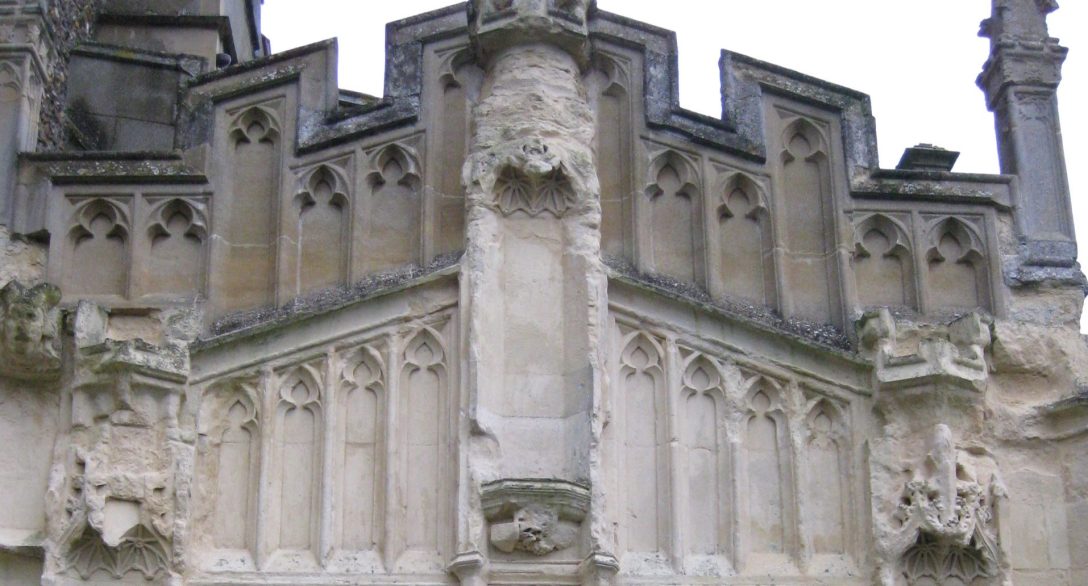
In the United Kingdom and in Europe, those who look at buildings, particularly churches, may come across a stone or wooden face wreathed in leaves, branches, or flowers. Sometimes benign in expression, sometimes as frightening as a Gothic grotesque, these architectural embellishments have been called “foliate heads” or “vegetal carvings” or, in the United Kingdom, The Green Man. So popular is the face of The Green Man, or the idea of it, that inns and pubs carry that name.

Theories abound as to why this pagan face was carved onto some churches: was the church built on a sacred site? Were the stonemasons having a lark, or were religious beliefs fluid enough to include Christian imagery and imagery connected to spring rebirth, be it Celtic or pre-Celtic? Does the Green Man represent a pagan god, an ancient spirit?
I expected to find the answer in The Golden Bough, but the Green Man is not in the index. Men dressed up in green leaves and branches are described many times, as James George Frazer describes spring fertility rites across the world, in particular those around May Day. He refers to the Slovenes’ Green George, and to England’s Jack-in-the-Green, a leaf-clad chimney-sweeper who wears a framework of wickerwork covered with holly and ivy. Hmm, not quite the Green Man I have in mind. But Frazer goes on: “Often the leaf-clad person who represents the spirit of vegetation is known as the king or the queen; thus, for example, he or she is called the May King, Whitsuntide King, Queen of May, and so on. These titles … imply that the spirit incorporate in vegetation is a ruler, whose creative power extends far and wide.” (p. 149) If the Green Man is a spirit of vegetation or a tree spirit that participates, in human or effigy form, in spring processions, why is his head on churches? Merging of customs was not, apparently, unheard of. Frazer talks about a custom in the Highlands of Scotland, in the Hebrides and in the Isle of Man, on St Bride’s Day, or February 1, involving a sheaf of oats or rushes, which he then connects to Brigit, the Celtic goddess of fire and crops. (p. 156)

And then there are the Druids, with their sacred oak trees. Frazer devotes a short chapter to The Worship of the Oak; although he writes a paragraph about the Celts and the Druids among them, with their sacred oaks, defining Druids as “oak men,” nowhere does he mention the Green Man. (Bearing in mind that I am using the abridged one volume edition of The Golden Bough, Macmillan, NY, 1951.)
According to Historic UK, the moniker The Green Man was coined by Lady Raglan for the Folklore journal in 1939. Before that it was just a foliate head or a vegetal carving. Historic UK accepts the Green Man as a pagan symbol of fertility or rebirth. A post by Liberty Rose Architects has a good selection of photos showing how the depiction of the Green Man has changed over time, and pointing out that it may be a universal symbol. On the Tales of Time Forgotten website, Spencer McDaniel debunks as Romantic the notion that the foliate head carvings were anything but decorative, and quotes Lady Raglan’s article as proof that the Green Man as pagan deity is a modern concept.

But what is the Green Man doing in Canada? This photo of the Green Man is from the Parliamentary Library website, which describes this wooden carving as a 44 cm diameter rosette, one of hundreds of rosettes in the library. Designed by architect Frederick J. Alexander, it was carved in the 1870s, although Alexander didn’t come to Ottawa until 1887. Why did he think it important to include the Green Man in the Parliamentary Library? . The Library of Parliament’s Collection Spotlight has only this to say: “The most recognizable rosette is the “Green Man.” His human face looks out calmly from twisting leaves and branches. The Green Man is a well-known mythological symbol.” The site speculates that the Green Man represents a link between the natural and human worlds. What do the other rosettes represent?
On a pillar at the bar of Patty’s Pub on Bank Street, there is a cast-iron Green Man, who looks friendly enough, with a great metal ring below his mouth, suggesting he was either a door knocker for a large door, or perhaps a hitch of some kind for boat or horse or waterbucket. I have not yet been able to find out where he came from, how old he is (original or decorative replica?) or why he is hanging in the pub. Are there others hanging about Ottawa?


 DEBRA MARTENS
Wow, you are so prolific.
The green man is such an intriguing subject. I enjoyed this.
Anyway, well done, you!
Barbara
Thanks for this, Debra! I always wondered what the Green Man represented. I purchased a pewter medallion of the Green Man at Rosslyn Chapel, the head surrounded by oak leaves and acorns. But I don’t remember seeing any carved into the stone work. Maria
I want to see it!